Recent Episodes
-

Leadership Loneliness
March 12, 2024
-
Your Future Self
March 5, 2024
-
Executive Presence
February 27, 2024
-
3 Keys to Rise in Any Organization
February 20, 2024
-
Annual Relationship Review
February 13, 2024
-
How to Be Your Own PR Person (And Why it Matters)
February 6, 2024
-
Why Coaching is the New Work Perk
January 30, 2024
-
Create a Winning Development Plan
January 23, 2024
-
Create a System for Goal Success
January 16, 2024


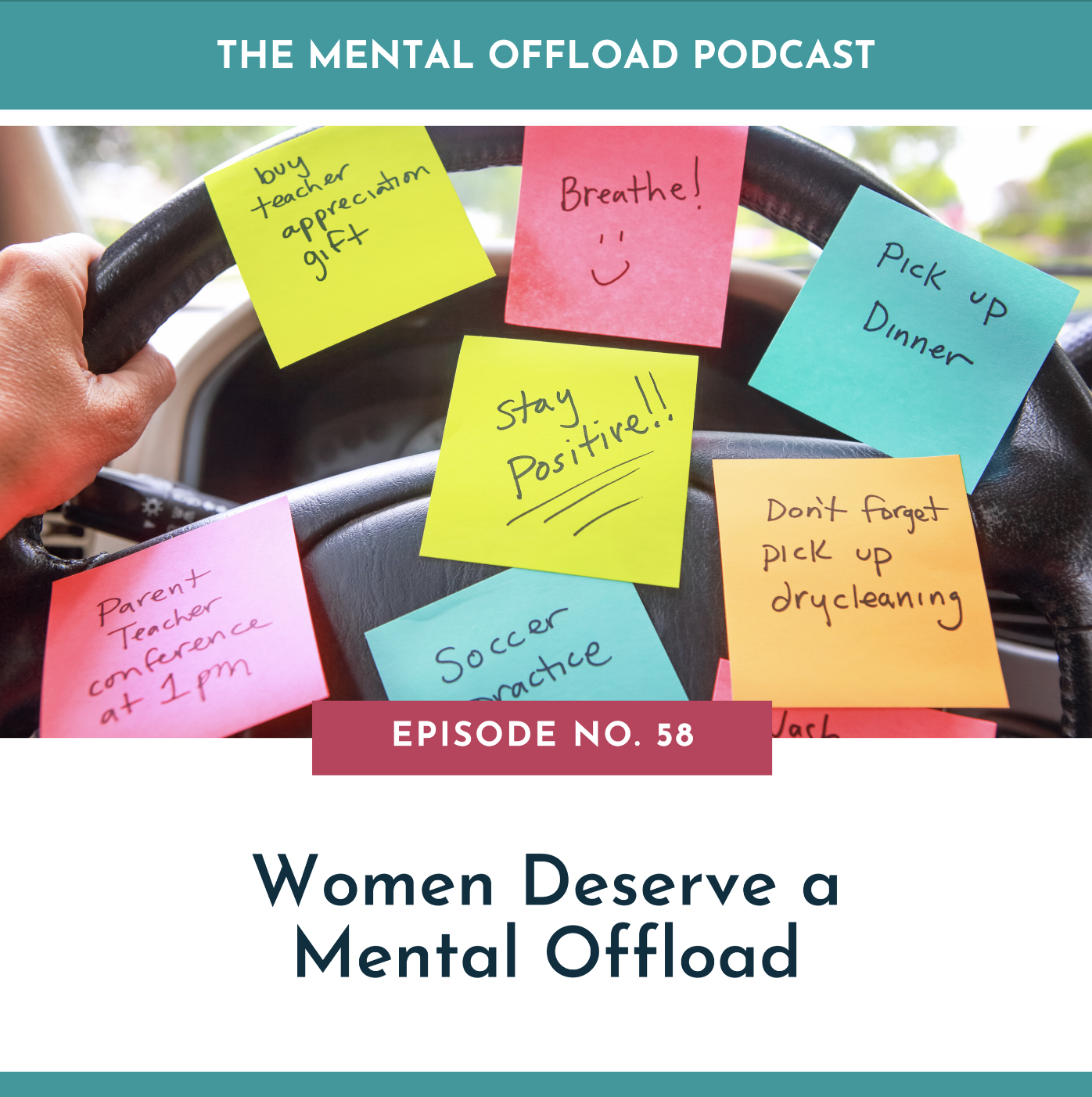
Women tend to disproportionately bear the weight of the mental load.
That translates into a “second shift” at home: more hours spent on parenting, housework, emotional caretaking, and more.
When it comes to managing that mental load, so often the advice to women is one of two things:
Delegate it. Or lower your standards.
And while there’s nothing wrong with either of those approaches, that’s not the only way to “offload” tasks.
I get on my soapbox a little bit this week, to talk about how the mental load ends up pigeon-holing women, the sexist taxes that (too often) go unchallenged, and why we deserve better.
It’s time to talk about what it really means to offload the mental load, and how we start to make that happen.
What You'll Learn
- Why going part-time isn’t your only option for being a “good mom” in the paid workforce
- The unchallenged assumptions that we need to rethink around the mental load of parenting.
- The “isn’t that cute” version of women’s empowerment
- The 3 sexist taxes that fall on you if you’re socialized as a woman
Featured in this Episode:
- Get The Mental Offload’s Shut Down Ritual
- Apply to join Offload
Listen to the Full Episode:
Full Episode Transcript:
Episode 58
Welcome to the Mental Offload podcast where we talk about women balancing work and life. It's the podcast that combines leadership, feminism and coaching. Tools. So you can tackle it all with more confidence and less stress. Here's your host Ivy League MBA certified feminist coach and corporate warrior, Shawna Samuel.
Hello Offloaders. This is Shawna Samuel. I'm the host of the Mental Offload Podcast. And today I'm going to ask you to buckle up a bit because I'm on a little bit of a tear. So originally I had planned this episode in line for International Women's Day, and I wanted it to be kind of inspiring and uplifting and, you know, really kind of fitting for the tone of that day. And as I was putting this together, I thought, oh, I think this is going to be a little inappropriate for that day. But I want to share with you what happened and why it happened and some of my reflections on it.
So I really started to rethink this episode as I I talked to a woman, very accomplished woman in a high-powered job and she's doing excellent, excellent work in her job. She's probably invested hundreds of thousands of dollars over the course of her life in her education. And yet she was like, I feel like I'm failing as a mom to the point where like maybe I should try to cut back to part time and let me state upfront there's absolutely nothing wrong with moving into part time paid work. I've worked with a lot of women whose goal has been exactly that. But where I get so disheartened and discouraged and and frankly downright pissed off is when women are made to feel like this is the only option if they want to be good moms and still be in the paid workforce. Like I just have to cut back my hours. That's the only way I can make this work. And it strikes me that I have never heard someone who's been socialized as a man have that same reflection. I'm sure it does happen. In fact I do know people who are stay at home dads. That's not the issue.
But I rarely hear this contemplation of like, I really need to think about going part time so that I can do my role as a dad and be in the paid workforce. It just does not happen as frequently. And why is that the case? I think so often it's because we treat the gender roles and the expectations in our households as fixed, as something that we should just accept without questioning. And then we need to make our time the flexible lever, the thing that we adjust to make everything else work. And I think the underlying assumption of that approach to women's work is really that our quote UN quote real job is our job at home. You know, it's kind of like the sort of isn't that cute version of women's liberation? Like, oh, isn't it, Isn't it cute if she goes and gets a job? Well, I mean, as long as nothing slips at home, right? And I mean, it's not 1950 anymore, so we're rarely confronted with people who say those words to us. But it's like there is this unspoken undercurrent that what really matters is our job at home and that that's the area that we can't let slip. And that is the mindset that leaves so many of us hustling for our self worth outside of our paid employment. Even if we have a really big demanding job, sometimes we really judge ourselves by the things that we're doing at home or as a parent. It's like, oh, did I?
Did I make homemade healthy meals every day this week? Did I do handcrafted Valentine's or store bought Valentine's for my kids school? Am I doing enough to contribute to the PTA? Think about whatever's on your personal list of like, am I doing enough here? And I want to stress, I mentioned those examples, not to throw shade on any single one of them, but I want you to consider whether you're doing any of those activities as a way to try to feel better about yourself, to, let's say, atone for some of the time you're taking away from your family for your job, or whether this is something that you truly want to do. It's really the difference between doing something from a place of wanting to do it versus doing it from a place of needing to do it. For example, I have a lot of clients for whom healthy meals is a really big thing on their list. But I've noticed there's a big difference between clients who are coming at this from a space of this is something that I want to do. It's genuinely important and interesting for me, or maybe not interesting in this case, but relaxing. And so when they're working on healthy meals for their family, they're feeling a sense of not just accomplishment, but also joy, pleasure, and they're able to be present with that because it's coming from that space of want versus those who are doing it from a space of need. Like I'm going to judge myself really harshly if I don't do this thing that seem task.
Making healthy meals is a source of pressure and stress, resentment, and the only thing they feel when it's done is like relief. There's not a whole lot of joy or enjoyment involved. And so instead of treating those gender roles and expectations as fixed, like, here's a list of stuff that needs to be done. And, you know, if I'm in a heterosexual relationship, then this falls to me and this falls other stuff falls to my spouse. Instead of treating that stuff as fixed, what if we saw our expectations and gender roles as flexible? Like, what if you were allowed to just like, dump all those expectations out onto a table and like, only pick up and put back in the ones that you really wanted to take on? You know, it's a little bit like spring cleaning for your brain. I was cleaning out my son's room over the weekend and literally did this exercise. Like, the bookshelf had just become too overcrowded with different Legos and art projects and stuff on the top of it. And we just dumped it all out and then started to go through it and be like, all right, which of these things do you actually want to put back up on display? And which are you done with for now? We can do that same thing for our expectations and for our brain. And I think it's super important that we talk about that as an option because when we don't, that's where women get stuck into thinking like, oh, I've just got to take these expectations as fixed and somehow try to figure out how to work my life around them. And I've heard this repeatedly when it comes to the idea of how to succeed as a woman with a demanding job and a family life. And it's like, I think a lot of people start this journey from a place of like, oh, I just need to learn how to productively do more things, like do more stuff, do it faster.
I was talking to someone literally yesterday who was saying, look, I've just become an expert at multitasking, and now I'm starting to figure out that that might not work right. So sometimes we think that as we're trying to get better, we just need to do more and do more productively. But at the next level, one of the things that I hear, and I think it's a little bit of a misconception about what it means to offload stuff, is this idea that like, OK, if you're going to do this successfully, it really just means like you need to get really good at learning how to delegate your tasks to other people or lower your own standards or say no to a whole bunch of things. And yes, it's super important to look at your own task list and start to figure out where you want to be spending your time. But that's never where I start. From an offload perspective, for me, offloading's not just about getting tasks off my task list. Doing a mental offload is fundamentally about removing that garbage conditioning from our brains. You know, the stuff that we've spent a lifetime absorbing and rethinking what you want to believe and do going forward. It's giving you full authority to reshape your role as a parent and as an employee.
And I feel super strongly about that because when we do that, that's when we see that we have options, right? We're not required to go part time to satisfy everybody else's expectations. We're not required to stay in the paid workforce and we're not required to drop out of it either. You know, it's like pulling out the old school paper map before you start a road trip and being like, oh, do I want the, you know, fast Interstate version of this journey or do I want like the Route 66 scenic route of this? All of these routes are there is no one universally right way to get from point A to point B. It's really about the experience that you want to have on that trip between those points. And I think that's a super radical notion in a society that tells us there's only one right way to get from point A to point B. And this work, this fundamental offloading of our societal conditioning, it's so important. Like, I would love to see this, like when you knew you were ready to expand your family and like you're having that appointment with your doctor or your adoption agency, I think they should offer you a session where they're like, look, it's time to offload. You're going to receive a lot of unhelpful messages and pressure about how to be a parent and do this all in the right way.
So now's the time when you should sit down and plan for how to deal with it so that you don't end up feeling like shit down the road. So look, we're a long way away from being in a place where those conversations are happening systematically in our lives. But I truly feel that every woman deserves to have those conversations. We deserve to have a mental offload because the alternative is that we unwittingly get hit with so much injustice. There's the injustice of women being expected to fulfill the role of default parent in so many households. This eats up our time. It also contributes to cognitive overload. This is a sexist time tax that's levied on primarily women in most households. Women also deserve to have the energy that we need to advocate for ourselves and for our families. We need that energy to be able to do our best work in the world, whether that work is in the paid workforce, blazing trails and breaking glass ceilings, or whether that work is out there advocating for safer schools and better education policies. But as long as we're trapped in these fixed expectations and gender roles, we're burning ourselves out trying to do it all. And what's truly frightening is that that continual burning through our own energy that's been linked to all sorts of chronic health issues and disease risks for women. So we're paying a sexist health tax as well. This attacks on not just our energy, but ultimately on our health and well-being. We also deserve to be able to invest in ourselves and our advancement without feeling guilty or selfish for doing that. I was thinking about this a lot as I was pricing my new group coaching programs Rise and and Offload, and I worked really hard to price them at a much more accessible level. So they're both priced at $1900, which is less than half of my normal one-on-one offerings. And and so I was thinking about that. I was like, oh, is that the right amount? Is that too much? And then I was looking at the cost of enrolling my kids in a summer camp in the US. And after having that momentary bout of sticker shock because I look at the cost of summer camps in the USI was like wow.
So many of us don't think twice about spending money on extracurriculars for our kids, or even on investments to help further our spouses career. And that's not to say that that's not a significant chunk of change or that we don't think carefully about it. But my point is that we don't question the value of making an investment in our kids or often times in our spouse. Sometimes we're like, oh, that's, that's prudent. But when it comes to spending on our own advancement, that somehow feels selfish for some of us. And then I thought about it again. I was like, wait a minute. Think about how much I spend each year on like haircuts or makeup or clothes or getting my nails done. And all that stuff is just temporary. But again, we don't necessarily think hard about the value of investing in things that are going to help us look good. And I think it was Gloria Steinem who first pointed out in an essay back in the 70s about how women are encouraged by society to invest in things that help us look good because that's where we assume our maximum value is versus investing in our own skills or advancement. And let me be clear, I'm not trying to say that everyone should go out and blow a bunch of money on themselves. That's not always the prudent or responsible thing to do, particularly if you're already really stretched financially. I'm not trying to tell you to go out and invest in one of my programs, especially since there are so many ways that you can get great value both right here for free on the podcast or my free master classes. But I am trying to make the point that there is this sexist money tax that a lot of us are paying in terms of where we're told it's OK to spend money on ourselves versus where it's not. So I strongly believe that we deserve to feel valuable enough to feel worthy and enough to invest in. We shouldn't have to feel like we're at the bottom of the hierarchy in our own families. What this welcomes back to for me, and this is clearly colored by my background being raised in America, is the idea that life, liberty, and the pursuit of happiness is something we all deserve and all should have claimed to.
And what truly outrageous me here, as we are in Women's History Month and we think about International Women's Day, is the injustice, the knowledge that as long as we're treating these expectations of women and their roles as fixed, then women don't fully get to participate in that promise of life, liberty, and the pursuit of happiness. Our lives get subsumed in service of other people. Our liberty is restricted by these sexist taxes on our time, our health and our money, and our happiness. We get sold on the lie that we might get happiness in the next season of our lives if we just successfully endure this season. We deserve better than this. And that's what I'm really here every week to advocate for. Thank you for being here with me. Let's go out and make some good trouble together.
Are you ready to step into a life for success at work and success at home? Go hand in hand and it's time for the Mental Offloads Shutdown Ritual. It's a proven, practical method to help you log off and leave work behind. You tan in your evenings and be present with the people you love. And the Shutdown ritual makes it easy gain the power to truly walk away from work and be present with the people who matter most to you. It's just what you need if you want to achieve big things in the world without losing your mind. Ready to reclaim your time and your Peace of Mind? Go to www.thementaloffload.com/shutdown and get your free download of the Shutdown Ritual. That's www.thementaloffload.com/sutdown and join me next week for the next episode of the Mental Offload Podcast.
Share this post on: